

The Copper Kettle Went Up on the Shelf the Week Loretta Opened Her Purse
Thirty-one years of truck-stop coffee, a kettle that took nine minutes, and a powder stick you tear and pour with no water. Eleven names on the panel, their amounts, and six weeks in a driver's log.

A word on the people first: Earl Whitacre is a pen name, and Carol and Loretta are composites of three retired drivers and two dispatchers who talk too much at breakfast.
Everything here about the product comes from the seller's own listing, its Supplement Facts panel, its review widget and its return policy, all read in October 2026.
The Morning Kettle doesn't sell anything. We read labels at the kitchen table before anybody in the family orders a box of something, and we print what we read.
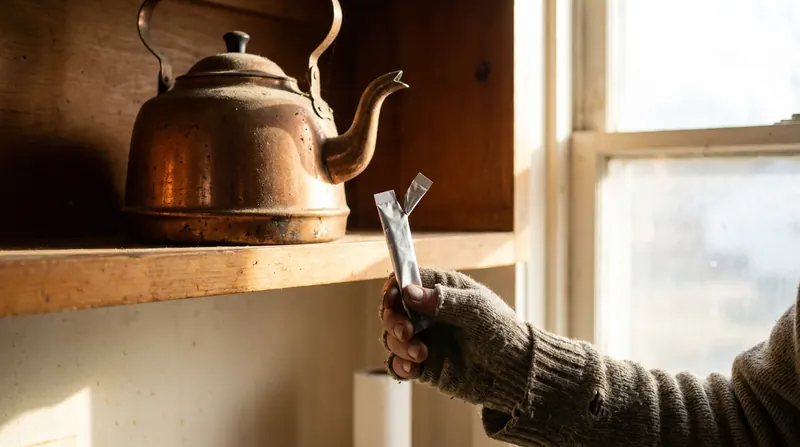
For thirty-one years I drove eighteen wheels across this country, and in all that time I never once owned a kettle.
A driver doesn't boil water. A driver buys coffee by the gallon at the fuel island and drinks it out of a thermos with a dent in the lid.
I hauled refrigerated freight out of Grand Island, Nebraska, mostly produce and dairy, mostly at night, mostly on Interstate 80 where the mile markers know your name.
Three million miles, give or take a detour, and two windshields that took a rock at seventy.
I retired in the spring of 2021. My wife Carol had been waiting on that day since about 1994, and she had plans for me that involved a kitchen.
The first thing she did was hand me a copper kettle that had belonged to her mother.
"You're home now," she said. "Home people make their coffee in a kettle."
I did not argue, because after thirty-one years of being gone four nights a week, a man learns which arguments to keep for later.
A Kettle That Took Nine Minutes Every Morning
That kettle is a beautiful thing. Hammered copper, a brass handle wrapped in cane, a whistle that sounds like a train two counties over.
It is also the slowest machine I have ever operated, and I once drove a 1979 Kenworth with a cracked radiator through the Wyoming wind.
I timed it the first week, because that's what a driver does with any machine. From cold tap to whistle, nine minutes on the big burner.
Nine minutes is a long time to stand in a kitchen at five forty in the morning when your whole body was trained to be rolling by then.
But I learned to like it, in a way. Carol would come down in her robe at the six-minute mark, and we'd talk about nothing until the whistle.
Those were the first unhurried mornings of my married life, and I won't pretend they didn't matter.
For about two years, the kettle was the clock of the house. Water on, dog out, paper in, whistle, coffee, talk.
Then the county called and asked if I'd drive the morning meal route for the senior center, and the clock got rearranged.
I said yes before Carol could catch my eye. A route is a route, even if it's eleven stops in a white minivan with hot trays in the back instead of forty thousand pounds of lettuce.
The meal route loads at six fifteen sharp at the church kitchen on Third Street. The kettle whistles at five forty-nine if I put it on at five forty.
That left me a margin of twenty-six minutes, which sounds like plenty until you count a dog, a shower, a tied shoe and a windshield with frost on it.
What the Doctor Said About My Labs
Last spring I went in for the yearly checkup, the one Carol books for me because I'd book it for 2031 if left alone.
The blood work came back, and my doctor did the thing where she turns the screen toward you and points with a pen.
"Your numbers are drifting, Earl," she said. "Not a cliff. A drift. The morning reading is a few points higher than I'd like, and it's been climbing a little each year."
Then she said the words every retired man hears sooner or later: walking, meals, the evening, and come back in six months.
I want to be plain about this part, because the rest of the story hangs on it. She did not hand me a product, and nobody should read this page as if she did.
She handed me a list: walk the dog farther, watch the plate after six o'clock, cut back on the sweet stuff at the fuel stops, and keep my appointments.
I have kept that list folded in my wallet since April. It's behind my CDL, which I still carry even though it expired, because a man doesn't throw away thirty-one years.
Carol read the list too, of course. She reads everything I bring home from that office, including the parking receipt.
And the next week, a tin of cinnamon tea appeared next to the copper kettle, because Carol has never met a problem she couldn't approach with a kettle.
Thirty-One Years of Keeping a Log Doesn't Stop at Retirement
Every long-haul driver of my generation kept a paper logbook before the electronic ones came in. Duty status, miles, the hours on and off, the line graph across the grid.
You learn to write it down, because the inspector at the scale house doesn't care what you remember. He cares what's on the paper.
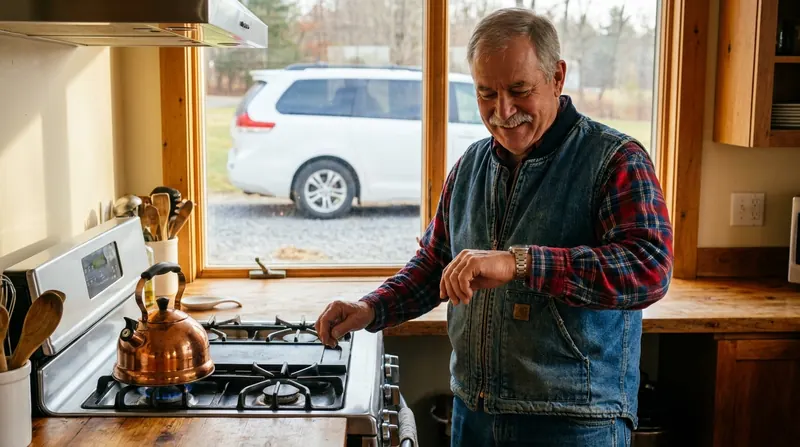
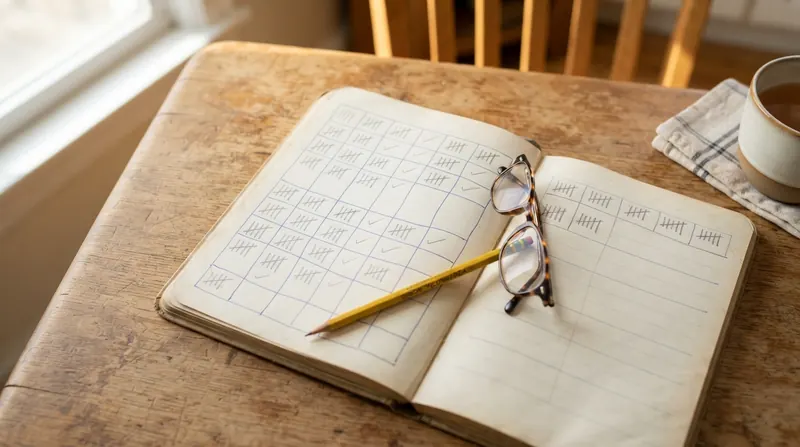
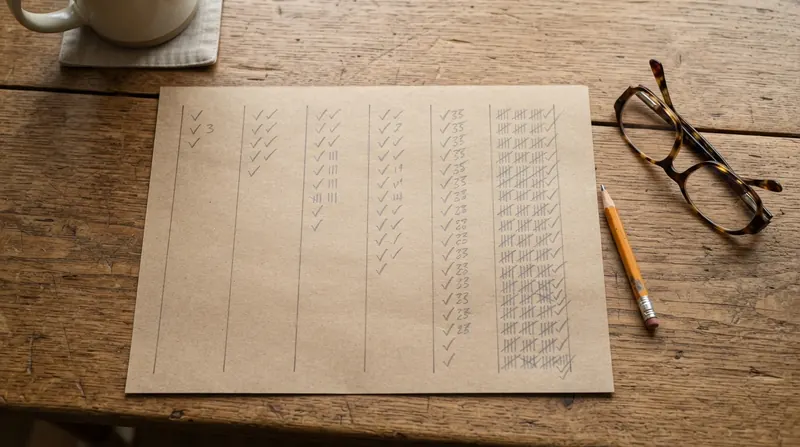
So when my doctor said "drift," I did what a driver does. I bought a logbook at the truck stop, the same kind I used in 1991, and I started logging my mornings.
Not my numbers. I don't own a meter and she didn't ask me to buy one.
I logged my habits, the things on her list, the things I could actually see.
Four columns, in pencil. Did I drink the kettle tea or skip it.
Did I stop for the 10:15 donut at the gas station on the route.
Did I open the cookie tin after supper. How many blocks did the dog get.
I'd like to tell you the log looked good. It didn't.
It looked like the log of a man who knew exactly what he was supposed to do and did about half of it.
The kettle column was the worst. On route days, which were five days out of seven, I skipped the tea four times out of five.
It wasn't the tea's fault. It was the nine minutes.
The tea needed the kettle, and the kettle needed time I'd already promised to the church kitchen.
The donut column was the second worst. When I skipped the tea, I'd get to the fourth stop on the route, the Hendersons on Maple, with nothing in me but coffee.
And by the sixth stop the gas station on Highway 30 would appear, as gas stations do, with a glazed donut in the case.
You don't drive for thirty-one years without learning the geography of a sweet roll. Every driver knows which exits have the good ones. My body still knew.
Ten-fifteen became the hour of the donut. Three or four times a week, logged in pencil, in my own hand, which is a hard thing for a man to read back to himself.
Why a Driver Eats the Way a Driver Eats
People who never drove for a living think truckers eat badly because they don't know better. That's not it.
We eat badly because the road is designed that way.
The fuel island is lit up like Christmas, and the food is next to the register, and the register is between you and the restroom.
For three decades my breakfast was whatever came out of a warmer at four in the morning in Ogallala or Laramie or Rawlins.
A sausage biscuit, a coffee the size of a paint can, and if the night had been long, a cinnamon roll for the dash.
My body learned a rhythm out there. Wake at three, eat something warm and sweet, drive till the sun came up, eat again at the next fuel stop, drive.
Sixty-four years old, and my stomach still thinks it's 1998 on the Wyoming line.
That's what I mean when I say the donut column wasn't about willpower. It was about thirty-one years of a clock that had never been reset.
A clock like that doesn't change because a doctor turns a screen. It changes one morning at a time, if it changes at all.

I'm telling you all this so you understand what I was up against when Carol's tea tin appeared next to the kettle.
It wasn't that I didn't want to drink the tea. I liked the tea.
Cinnamon and something warm, a cup that made the kitchen smell like Christmas morning.
The trouble was always the kettle. The kettle was the gate, and the gate opened at five forty-nine, and on route days I was gone at six oh-four.
Some mornings I'd put the kettle on, get dressed, and come back to find it whistling at an empty kitchen. Carol would turn it off and pour herself the cup I didn't drink.
"At least one of us is following that list," she said once, and she was not wrong, which is Carol's least attractive quality and her most reliable one.
The Week the Kettle Column Went Blank
In July the senior center added four stops to the meal route, out past the county line, and the load time moved up to five fifty.
Now the kettle couldn't even whistle before I left. The tea column in my log went blank for nineteen days straight.
The donut column did not go blank. It did the opposite.
With four more stops and an earlier start, I was hungrier by the sixth stop than I'd been in years.
I want to be honest about how that felt, because I think a lot of men my age know this feeling and don't say it out loud.
It felt like failing a test I had written the answers to myself. The list was in my wallet. The tea was on the counter. The kettle was right there.
And still, every morning at five forty, I'd look at that copper kettle and do the math, and the math said no.
A man can only lose a race with a kitchen appliance so many times before he stops entering it.
Carol saw it, of course. She sees everything, including the cinnamon sugar on my shirt cuff that I swore was from the meal trays.
"Earl," she said, "you need a tea that doesn't need a kettle." I told her that was called coffee, and she gave me the look she's been perfecting since 1979.
The list was never the problem. The nine minutes were the problem.

The Dispatcher Who Never Missed a Detail
Every Wednesday, a dozen of us old drivers meet for breakfast at the truck stop diner off exit 312. Same booth by the window, same waitress, same arguments about Peterbilt versus Kenworth.
We call it the Wednesday Convoy, which is a grander name than a table of retired men with reading glasses deserves.
Loretta Haines comes most weeks. Loretta was the night dispatcher at my old company for twenty-six years, the voice on the radio at two in the morning when the reefer quit in a snowstorm.
If you drove for that outfit, Loretta knew where you were, what you were hauling, and whether you'd eaten. She still does, somehow.
She's sixty-eight now, retired, a grandmother of five, and she runs a church bus trip twice a year to places like Branson and the Smoky Mountains.
She has a purse the size of a sleeper berth, and in it, as far as any of us can tell, is everything a person could need for a week on the road.
The Wednesday after my nineteen blank days, I sat down across from Loretta looking, she said later, like a man who'd been hauling a load he couldn't deliver.
"Whitacre," she said, "you look like you lost a fight with a cinnamon roll."
I told her about the doctor, the list, the copper kettle and the nine minutes. I told her about the 10:15 donut, because you can't lie to a dispatcher. They have your logs.
She listened the way she used to listen on the radio, without interrupting, while she stirred her coffee with the wrong end of a spoon.
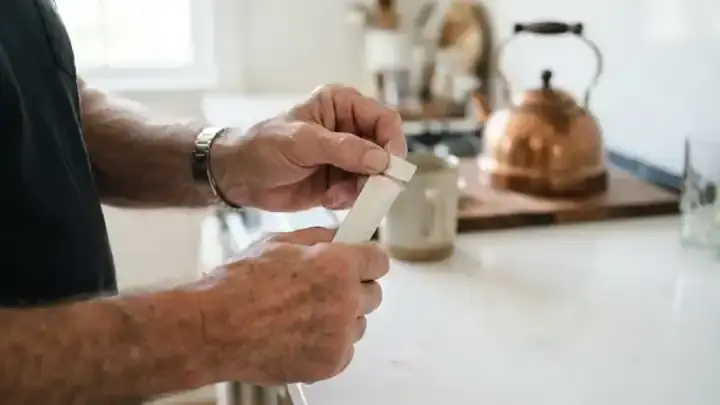
Then she reached into that purse and came out with a long, skinny packet, about the size of a stick of gum but longer, and she tore the top off with her teeth.

She tipped her head back and poured it straight onto her tongue. A little cloud of pale pink powder.
Then she closed her mouth and smiled like she'd won a hand of gin rummy.
"Rainbow sherbet," she said. "Don't make that face, Earl. You haven't tasted it."
What Loretta Had Figured Out on the Church Bus
Loretta explained it the way she used to explain a reroute: short, clear, with no wasted words.
Two years ago her own doctor had given her a list, a lot like mine. Walk, watch the evenings, the sweets, come back in six months.
"And I'm good at home," she said. "Home has a kitchen. But on the bus trips I'm in a motel in Pigeon Forge with a coffee maker that smells like the last guest's hair."
"You can't make tea in a motel, Earl. Not real tea. So I went looking for something I could carry."
She'd tried a few things. Fiber powders you stir into water, which on a bus means stirring into a bottle with a pen cap.
Teas in bags, which still need hot water.
Then her granddaughter showed her these sticks on the phone, and Loretta, being Loretta, read the whole back of the box before she bought one.
"I'm not telling you it fixes anything," she said, and she said it twice, which is how I knew she meant it. "I'm telling you it fits in a purse and it doesn't need a kettle."
"And I'm telling you to read the panel yourself, because you were always a driver who read the bill of lading."
She pressed two of the sticks into my hand, wrapped in a diner napkin like contraband. "Read the box first. Then try one. Then tell me on Wednesday."
That was the whole sales pitch, if you can call it one. A dispatcher handing a driver a load and telling him to check the paperwork.
I drove home with the two sticks in the chest pocket of my vest. The same pocket where I used to keep the fuel card and a roll of antacids.
They weighed almost nothing. That was the first thing I noticed, and it turned out to be the whole point.
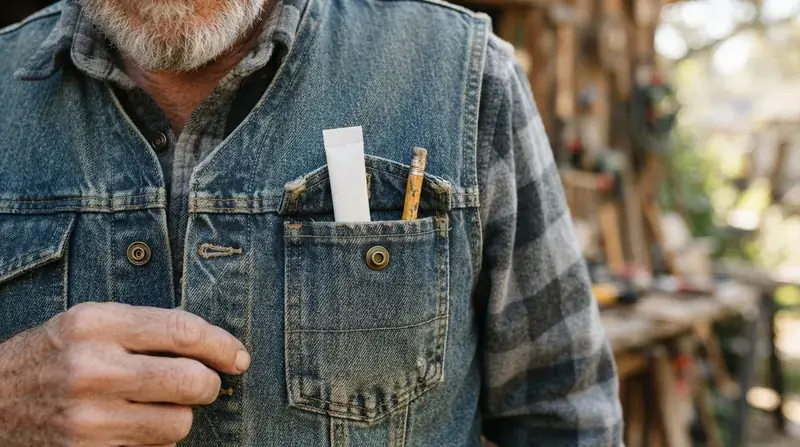
Carol found them that evening, because Carol empties my pockets before laundry the way customs empties a suitcase.
She held one up to the kitchen light. "Loretta?" she said.
I nodded. "Of course Loretta," she said, and went to get her reading glasses.
Ordering a Box, and Reading It at the Kitchen Table
The two sticks from Loretta gave me two mornings, and I'll tell you about those in a minute. But a driver doesn't haul on somebody else's paperwork forever.
So that weekend, Carol and I looked up the seller and ordered one box, the single pack, and we read the listing together before we clicked anything.
The product is called Gluco Stix. It's sold by a company called Clean Nutra, which is the trade name of Allseason Enterprises LLC, with an address on Las Vegas Boulevard in Las Vegas, Nevada.
The box says "Distributed By: Allseason Enterprises, LLC" on the side, with a phone number, (866) 221-7374, and an email, [email protected].
One thing I want you to know up front: the phone number is printed on the box, not on the website. The website gives you the email, a mailing address and a contact form.
Carol wrote both down on the inside of the pantry door, where she keeps every number that matters, right under the vet and the plumber.
The box arrived in four days. It's small, about the size of a deck of cards stood on end, and inside are twenty sticks.
Not thirty. Twenty.
I mention it because I'd assumed thirty, the way you assume a month, and a driver who assumes the load count gets a phone call from a receiver.
Each stick holds 2.2 grams of powder. The whole box weighs 1.6 ounces, which is less than the cinnamon roll I used to buy in Rawlins.
The flavor is printed as "Clean Rainbow Sherbet," and the front says, in big letters, that you just rip it and take it, no water needed.
The Supplement Facts, Read Line by Line
Carol and I read the Supplement Facts panel at the kitchen table on a Sunday afternoon with the radio on.
She read it out loud and I wrote it in the log, the way Loretta used to read me a load sheet.
I'm going to give it to you the same way, line by line, with what we found when we looked each one up.
The serving size is one stick, 2.2 grams, and there are twenty servings in the box. Total carbohydrate is less than one gram per stick.
The seller's page counts "11 nutrients and botanicals," and I counted them myself with a pencil. Eleven is right, if you count the raspberry and strawberry powders as one line.
Line one: chromium, 1,000 micrograms, as chromium picolinate. That's printed as 2,857 percent of the Daily Value, which is the biggest number on the panel by a long road.
Chromium is a trace mineral. The National Institutes of Health calls it an essential mineral involved in how the body handles carbohydrates, fats and proteins. [1]
The same NIH fact sheet says the mineral's role in how the body uses insulin is an area of ongoing research, which is government language for "we're still working on it." [1]
And the FDA only allows what it calls a qualified health claim for chromium picolinate, which means the agency itself says the evidence behind it is limited.
I like that the panel prints the amount instead of hiding it. I also noticed that 2,857 percent is a lot of percent.
NIH hasn't set an upper limit for chromium, but Carol wrote "ask at the January appointment" next to that line, and that's where it stays.
Line two: vitamin D3, 62.5 micrograms, as cholecalciferol. That's 2,500 IU, printed as 313 percent of the Daily Value.
A lot of men my age already take vitamin D, sometimes in a multivitamin, sometimes on their own. Carol checked our cabinet so we wouldn't double up without knowing it.
Line three: vitamin C, 45 milligrams, as ascorbic acid. Half the Daily Value. About what you'd get in half an orange.
It's also part of why the powder has a little tang to it, along with the citric acid further down the label.
Line four: konjac glucomannan tuber extract, 50 milligrams. Glucomannan is a fiber from the root of the konjac plant, the same root they make those clear noodles out of.
The seller's page says the fiber-rich ingredients support satiety and digestive comfort.
I'll be honest about the size: 50 milligrams is a small pinch of fiber, a lot smaller than a spoonful of anything.
Line five: Ceylon cinnamon bark extract, 33.4 milligrams. Ceylon is the softer, lighter cinnamon, the one the spice books call "true" cinnamon, and it carries much less coumarin than the cassia kind in most grocery jars.
On cinnamon, I'll quote the government plainly: human studies show mixed results, some reviews report modest changes in fasting numbers, others find nothing, and the NIH says there isn't enough evidence to conclude it helps any health condition. [2]
Line six: green tea leaf extract, 33.33 milligrams. The panel doesn't print a caffeine figure for it, and green tea does naturally contain some caffeine. [3]
At a third of a gram of extract, I didn't feel it next to my two cups of coffee, but if you're a person who counts caffeine, that's a question for the email address.
The Fifty-Milligram Line, and the Five Names Inside It
Line seven is where the panel gets crowded. It's printed as a "Proprietary Blood Sugar Blend," 50 milligrams total, and the label doesn't say how much of each thing is inside.
That's the label's name for it, not mine, and I copy it here only because a driver writes down what the paperwork says.
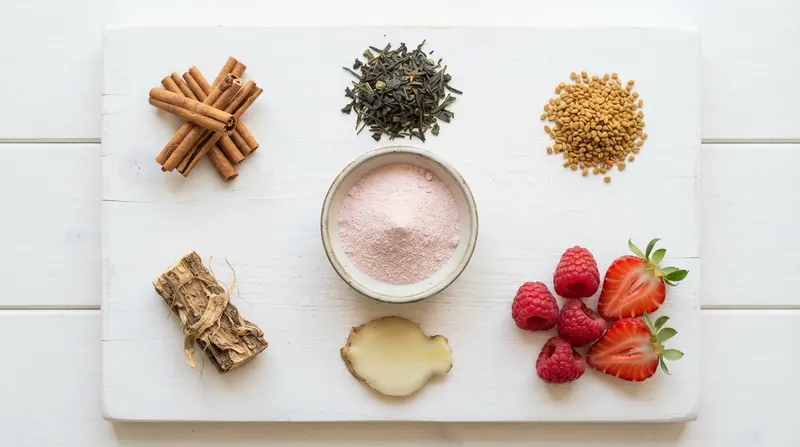
Inside those 50 milligrams are six items: chicory root extract, standardized to 90 percent; inositol, as myo-inositol; berberine bark extract from Berberis aristata, a ten-to-one extract; fenugreek seed extract; and raspberry and strawberry juice powders.
Six names sharing 50 milligrams means each one is, on average, about eight milligrams. Some may be more and some less.
The panel doesn't say, and I won't guess.
Chicory root is the root of the blue-flowered roadside plant you see along every county road in July.
It's mostly a fiber called inulin, and roasted, it's the stuff New Orleans puts in its coffee.
Myo-inositol was the one that taught us something. It used to be counted among the B vitamins, until scientists found that the body makes its own from glucose, up to four or five grams a day, mostly in the kidneys. [4]
Four or five grams a day, made by your own body. Whatever share of 50 milligrams is myo-inositol, it's a small spoon next to a factory that big.
Carol thought that was the most interesting line on the box.
Berberine is a bright yellow compound from the bark and roots of barberry plants. Indian barberry, Berberis aristata, is the one on this panel, as a ten-to-one bark extract.
You'll find a lot of loud talk about berberine on the internet. I'm not going to repeat any of it, because the box doesn't, and because a few milligrams in a shared blend is not what the loud talk is about.
Fenugreek is a kitchen seed, small and golden, that smells like maple syrup when you toast it. It's in curry powder and it's an old ingredient in Middle Eastern and Indian cooking.
Raspberry and strawberry juice powders close out the blend. Carol says they're the reason the stick tastes like a sherbet push-pop and not like a spice cabinet, and I think she's right.
Then there are the "other ingredients," the part of a label most people skip: xylitol, erythritol, natural flavors, citric acid, maltodextrin and stevia.
The box says zero sugar, sweetened with stevia and sugar alcohols, with no added sugars or dyes.
That xylitol line matters in our house, and here's why. The FDA says xylitol is absorbed quickly in dogs and can be dangerous for them, even in small amounts. [5]
We have a beagle named Diesel who has eaten, in his career, a dish towel, a tube of lip balm and most of a church bulletin. The sticks live in a cabinet now, up high, next to the kettle.
And one more honest line from the paperwork: the seller publishes no study of Gluco Stix itself.
There's no trial of the stick, no week-one-versus-week-twelve chart, nothing like that on the page.
What there is, is a list of ingredients with amounts beside most of them, and research on some of those ingredients that ranges from "ongoing" to "mixed."
"A complete all-in-one supplement formula designed to support balanced wellness and healthy glucose metabolism—all in a convenient, no-water-needed format."
— The seller's listing, Clean Nutra product description, read October 2026
That's their sentence, word for word, from the listing. I want you to notice the verbs: designed to support.
Not fixes. Not lowers. Support.
It's the language of a company staying inside its own lane, and after three million miles I've got a lot of respect for anybody who stays in their lane.
What the Stick Is, and What It Isn't
So here's how it works, in practice, at five fifty in the morning in a kitchen in Nebraska.
You tear the top off the stick along the notch. You tip your head back like you're taking the last of a bag of peanuts. You pour.
The powder is fine and pale pink, and it lands on your tongue a little dusty and then melts in a couple of seconds.
The box says "these delicious powders melt on your tongue," and for once a box isn't exaggerating.
The whole thing takes about as long as reading this paragraph. I timed it, of course. Eleven seconds, including folding the empty stick into my vest pocket.
The seller's own instructions are short: tear open one stick, pour the contents directly into your mouth, no water or mixing required, once daily or as directed.
That's the entire ritual. There's no scoop, no shaker bottle, no kettle, no cup to wash.
Now, because I promised Loretta I'd be honest and because Carol reads everything I write, here's the list of what this stick is not.
- It is not a tea. There's no cup, no steam and no nine minutes of standing at the stove.
- It is not a meal, and it doesn't replace breakfast. I still eat an egg and a piece of toast before the route.
- It is not a fiber supplement in the usual sense. Fifty milligrams of glucomannan is a pinch, not a spoonful.
- It is not something to swallow whole. It's a powder that melts; there's nothing to get down with water.
- It is not a stand-in for my doctor's list. The walk, the plate after six and the January appointment all still happen.
- It is not sugar. The sweetness comes from stevia and sugar alcohols, per the box.
The seller's page uses three phrases I'll repeat exactly, because a driver doesn't paraphrase a bill of lading.
It says the sticks "help support energy balance, satiety, and digestive comfort," and that they are "designed to support balanced wellness and healthy glucose metabolism."
Every claim on the box carries the little asterisk, and the asterisk leads to the sentence every supplement label carries: these statements have not been evaluated by the Food and Drug Administration. [6]
I read that sentence as a promise of a different kind. It's the company telling you, in the fine print, exactly how much weight to put on everything above it.
What Rainbow Sherbet Tastes Like at Five Fifty in the Morning
The first stick Loretta gave me, I took on a Thursday, standing at the counter in the dark, with the copper kettle cold on the back burner.
It tasted like the sherbet cups they used to hand out at the Fourth of July picnic in Grand Island, orange and raspberry and lime all in one paper cup.
Sweet, but not syrup-sweet. A little tart from the citric acid.
A very faint warm note underneath that I think is the cinnamon, though Carol says I'm imagining it.
And a dry, chalky second or two before it melts, like the powder on a stick of chewing gum.
I did not love it the first morning, I'll admit that. My mouth expected coffee and got a county fair.
By the fourth morning I was used to it. By the second week I found myself reaching for my vest pocket at the church kitchen loading dock like I used to reach for the thermos.
Carol tried one, standing at the sink in her robe, and made a face I've only seen her make at my brother-in-law's chili. "It's a children's party," she said.
Then she took another one the next morning, which tells you something, though I'm not sure what.
Took Loretta's stick at the counter. Kettle never left the shelf.
6:04I heard you not filling it. What did it taste like?
6:09The Fourth of July picnic. Sherbet cup and all.
6:10Leave the box out tonight. I want my glasses on it first.
6:12
Friday, the Long Route, and the Sixth Stop
The second stick from Loretta's napkin, I saved for Friday. Friday is the long route, the one with the four new stops past the county line.
It's also the day the donut column had been at its worst all summer, so if I was going to learn anything, I figured Friday was the day to learn it.
I took it at the loading dock at five fifty-two, the way I'd later take all of them. Tear, pour, fold, and the empty wrapper went in the vest next to the route sheet.
Then I drove the route the way I'd driven it a hundred times, Hendersons on Maple, the Kowalskis with the porch ramp, Mrs. Ortiz who always has a word about the weather.
At the sixth stop, the gas station on Highway 30 came up on the right like it always does. I'd like to tell you something big happened. It didn't.
I slowed down, the way my hands had learned to, and then I just kept going, because I had eleven more trays in the back and Mrs. Albers doesn't like her lunch cold.
I want to be careful about what that morning means, because it's easy to make too much of one Friday. One morning is not a pattern. A driver knows the difference between one good trip and a good season.
Maybe I kept driving because of the stick. Maybe because I'd had an egg at home. Maybe because Loretta's voice was in my head telling me to read the paperwork.
What I can tell you is that I wrote it down. Friday, route day, stick at the dock, no stop at the sixth. Pencil, in the log, in my own hand.
And on Saturday morning I took the copper kettle down off the shelf, made Carol and myself a cup of her cinnamon tea, and told her about it.
She listened the way she's listened to thirty-one years of road stories, which is to say with one eyebrow up.
"One Friday," she said. "Order a box and give it six weeks. Then tell me." That's Carol. She's been my dispatcher at home for forty-six years, and she's never once let me log a load I hadn't delivered.
An Honest Word for the Kettle
I want to stop here and say something fair about the copper kettle, because this page is named for it and because Carol's mother would come back and haunt me if I didn't.
The kettle was never the enemy. The kettle gave me the first slow mornings I ever had with my wife. Nine minutes of standing together in a kitchen is not a waste of nine minutes.
Tea in a kettle and a powder in a stick are two different things doing two different jobs.
A cup of tea is warm, it's slow, it makes you sit down, and it makes the whole house smell like somebody's home.
A stick is eleven seconds and an empty wrapper. It doesn't make you sit down. It lets you leave.
There are good teas out there, sold by honest tea houses, that people drink from a kettle for the same reasons I'm writing about. Cinnamon teas, herbal blends, the kind Carol keeps in a tin.
If your mornings have nine minutes in them, the kettle is a fine way to spend them, and I'd never talk a man out of a warm cup.
My problem was that my mornings didn't have nine minutes anymore. The route took them.
And for a man whose problem is minutes, the answer has to be something that costs none.
That's the whole contrast, as plain as I can make it: the kettle asks for your time, and the stick asks for your pocket.
The kettle asks for your time. The stick asks for your pocket.
These days, on route days, the stick goes in at the loading dock. On Saturdays and Sundays, the kettle comes down off the shelf and Carol and I have our nine minutes, tea and all.
So the title of this column isn't quite fair to the kettle. It went up on the shelf on weekdays.
It comes down on weekends. That's a better arrangement than the one we had.

Thirty-One Years in One Pocket
Every driver I ever knew had one pocket that mattered. For some it was the shirt pocket, for some the left hip, for Ray it was a zippered thing on the sun visor that he'd defend with his life.
For me it was the chest pocket of a denim vest. I've owned four of those vests since 1990, and the pocket has always held the same kind of cargo.
In the road years, that pocket held the fuel card, a short pencil for the log, a roll of antacids, the bill of lading for whatever was in the trailer, and a photograph of Carol from 1983 in a plastic sleeve.
A man's pocket is his real logbook. You can tell everything about a driver by what he's carrying over his heart at three in the morning in Rawlins.
When I retired, the pocket got lighter. The fuel card went back to the company. The bill of lading went in a drawer.
The antacids stayed, for a while, until Carol replaced them with a pack of sugar-free mints.
The pencil and the photograph never left. I'm not sentimental about much, but I'm sentimental about that pocket.
So when Loretta put two sticks in my hand at the diner, the pocket is where they went without my even thinking about it. It's where things go that I mean to keep track of.
And that, more than the flavor or the panel or anything on the seller's page, is why the routine stuck.
A kettle lives in the kitchen. A tea tin lives in the pantry.
A stick lives on you. It rides along to the loading dock, to the Hendersons on Maple, to the gas station on Highway 30 where the glazed donuts wait in the case.
It doesn't make the donut disappear. Nothing does that.
But it's there, in the same pocket as the photograph, the pencil and the folded list from my doctor.
I've noticed something about that. When I reach for the pencil to log a stop, my fingers find the stick.
When I reach for the stick at the loading dock, my fingers find the photograph.
It's a small thing. It's the kind of small thing that a routine is built out of, the way a long haul is built out of mile markers nobody remembers.
Carol says I'm making a philosophy out of a pocket. She's right.
But after thirty-one years of being alone in a cab, a man is allowed a philosophy or two, as long as he keeps it short and checks his mirrors.
Grandma says you carry candy in your vest now.
4:31Not candy. A powder stick. Tear the top, pour, done. No water.
4:40No water at all? Like the Pixy Stix at the county fair?
4:41Quieter. It rides next to the pencil and the picture of your grandmother.
4:43Of course it does. Same pocket since 1990.
4:44Where the Stick Goes in a Driver's Morning
A routine only works if it's tied to something you already do. Every driver knows this.
You check the tires when you fuel, because you're already standing next to them.
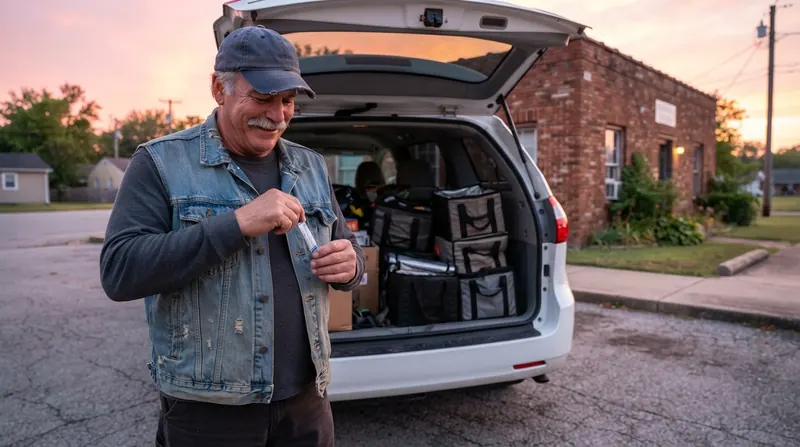
So I tied the stick to the loading dock at the church kitchen, where I already stand for four minutes every morning waiting for the hot trays.
Five fifty: the van backs up to the side door. Five fifty-one: the volunteers start handing out the insulated bags.
Five fifty-two: I reach into my vest, tear, pour, fold, done.
By the time Bernice from the kitchen hands me the first tray, it's over, and the empty stick is in my pocket with the route sheet.
On Saturdays I take it at the kitchen table with Carol, after the tea. On Sundays I've forgotten it twice, because Sunday has no loading dock, and I logged both of those honestly.
Once a day, the box says. I don't take more.
I don't see any reason a man would, and the box doesn't suggest it.
I keep three sticks at a time in the vest. One for today, one for the cooler in the van in case I forget, and one for Loretta's bus trips, because she always runs out by the third motel.
The rest stay in the box, up high, next to the kettle, where Diesel can't reach them.
The Questions a Careful Man Asks Before He Starts
Thirty-one years of pre-trip inspections teach you to look before you roll.
So before I took the second stick, Carol and I made a short list of questions, and I'll share them in case they're useful to you.
- Is anything on this panel already in something I take? We checked for vitamin D and chromium in the cabinet.
- Is anybody in the house allergic to anything on it? Fenugreek is a legume relative, which matters for some people with peanut allergies.
- Does anything here belong on the list I bring to the doctor? Chromium at 2,857 percent of the Daily Value went straight on ours.
- Who answers if something goes wrong? [email protected], and (866) 221-7374 from the side of the box.
- What's the return policy, exactly? We read it before we ordered, and I'll print it further down.
I'll add one more, because it's the one that matters most for men my age. If your doctor has you on anything for your numbers, the box goes with you to the next appointment.
Not because the box says anything alarming. Because your doctor should know everything you put in your mouth on purpose, and a powder is something you put in your mouth on purpose.
The box doesn't print warnings about pregnancy or about other products, and the website didn't show any either when we looked. That's not a reason to worry. It's a reason to ask.
A driver never assumes the brakes are fine because nobody told him they weren't.
Two Reviews, Quoted Whole, and Why There Aren't More
Now the reviews. I'm going to be more careful here than most pages are, because the review section is where most pages stop being honest.
Gluco Stix is a new product. The seller's listing went up in the summer of 2025, and when we checked in October 2026, the review widget showed exactly two reviews.
Two reviews, averaging 4.5 out of 5. One five-star and one four-star. Both are marked as verified buyers by the review widget.
Here they are, word for word, typos and all, the way a driver copies a seal number.
"I love the gluco stix… this is my go to when traveling away from home."
"Great i love it"
That's it. That's the whole wall. I'm not going to dress it up.
The first one, "my go to when traveling away from home," is exactly Loretta's reason, which made Carol laugh out loud at the kitchen table.
Somebody else out there has a motel coffee maker problem too.
Now here's the part I want you to watch for, because it's the kind of thing a careful reader catches. The seller's product page also shows other review sections further down.
One is a carousel labeled "Amazon Review," and one is a banner about "500,000+ Happy Customers," with quotes from people with first names and initials.
Neither of those sections says which product the reviews are about. Clean Nutra sells a lot of products.
Those reviews might be about any of them.
So I didn't use them, and I won't quote them here. Two honest reviews of this product are worth more to me than twenty of somebody else's.
If you're the kind of reader who wants a big pile of reviews before you try something, I understand that completely. This product doesn't have one yet.
That's a reason to lean on the return policy, which I'll get to, and on your own log, which is the only review that's really about you.
What the Breakfast Table Said
I brought the box to the Wednesday breakfast after my first week. Not to sell anything.
Just because Loretta had asked, and because a table of retired drivers will tell you exactly what they think of anything you put on it.
Hector, who hauled cattle out of Ogallala for twenty years, picked up a stick and read the panel with his arm fully extended because he won't admit he needs reading glasses.
"Two thousand eight hundred percent," he said. "Of what?"
I told him chromium. He said his wife takes chromium in her multivitamin, and he'd ask her. That's the right answer, Hector.
Ray, who drove flatbed and still has the forearms to prove it, tore one open right there and poured it in.
He chewed on it like it was jerky. "Tastes like my granddaughter's lip gloss," he said.
Then he asked if they made a coffee flavor. They don't, as far as I could find.
Ray was disappointed, and he said so for most of breakfast.
Big Walt, who doesn't say much, read the whole box front to back, set it down, and said, "At least they print the numbers." From Walt, that's a five-star review.
And Loretta just sat there stirring her coffee with the wrong end of the spoon, looking like a dispatcher whose load got delivered on time.

I want to be clear that none of those men are reviewers, and none of them took the stick for more than a morning.
They're my friends, and their opinions are about taste and paperwork, not about results.
I put them in this column because the breakfast table is where a man decides what to try, not the internet.
Window booth tomorrow? I'm bringing the thermos with the dent in the lid.
8:15Window booth. Mine's on the shelf next to Carol's kettle now.
8:18Thirty years of fuel island coffee in that thermos and you retired it?
8:19Still have two cups at home. The stick rides in the vest for the route.
8:21You and your stick. Save me the end of the booth.
8:22Six Weeks in a Driver's Log
Here's the part Loretta asked for. Six weeks of my morning log, from the first box to the week I'm writing this.
I'll give it to you the way I'd give it to an inspector: what's on the paper, nothing added.
These are habits I logged, not numbers from a lab. I haven't been back to the doctor yet. That's in January.
Earl's morning log, September to October
- Week 1Five route days, five sticks at the loading dock. Donut stops: three. The kettle came down Saturday. Taste: "a county fair." Nothing else to report.
- Week 2Forgot the stick twice, both Sundays-type mornings with no loading dock. Donut stops: three. Started keeping a spare in the van's cooler.
- Week 3Seven of seven. Donut stops: two. Dog walk added a block past the grain elevator. Can't say why the donuts dropped. Logged it anyway.
- Week 4Bad week. Grandson's birthday, two pieces of cake, and a donut stop on Friday out of pure habit. The stick doesn't argue with cake.
- Week 5Seven of seven. Donut stops: one. Diesel and I did the long loop by the river three mornings. Carol said I seemed less "drifty" at lunch.
- Week 6Seven of seven. Donut stops: one. Kettle mornings on both weekend days. The log is still a log, and January is still January.
Week one, nothing to report. I want you to read that line twice, the way I'd want you to read a weight ticket twice.
Anybody who tells you something changed in week one is selling you week one.
The stick tasted odd, the donut stops held at three, and the only thing that changed was where I stood at five fifty-two.
Week two, I forgot it twice. Both times on mornings without a route. That taught me the same thing every routine teaches you: it lives or dies by what it's tied to.
So I put a spare stick in the cooler in the van, the same cooler that's held a sandwich since 1990, and I haven't missed a route day since.
Week three, the donut column dropped to two. I want to be careful here. I don't know why.
It might be the stick. It might be the extra block with Diesel.
It might be that I was paying attention for once.
The seller's page uses the word satiety, and I won't pretend to know what 50 milligrams of fiber did or didn't do. All I know is what the pencil says.
Week four was a bad week, and I'm logging it in this column because a log with no bad weeks is a log somebody rewrote.
My grandson turned eleven, Carol baked a chocolate sheet cake, and I had two pieces. On Friday I stopped at the gas station on Highway 30 for no reason except that my hands turned the wheel.
Week five and six, the donut column sat at one. One stop a week, usually Friday, usually the long route. Diesel got the long loop by the river three or four mornings a week.
And Carol said something at lunch one day that I wrote in the margin: "You seem less drifty in the afternoons." I don't know what that means scientifically. I know what it means to me.
Here's the honest summary of the log, and I'll stand behind every word: my habits got a little better, the stick was the easiest part of the list to keep, and I can't tell you which part did what.
The real test is the January appointment, when my doctor turns that screen around again. Whatever it says, I'll bring the log, the box and the folded list from my wallet.

What Other Readers Asked About the Kettle Column
When an early version of this column went around our church bulletin and two retired drivers' groups online, the comments came in the way comments do: some kind, some sharp, all of them worth reading.
Here are a few of them, with the questions they raised.
The comments above are illustrative, written from the kinds of questions readers sent about this column; names and towns are composites, like the people in the story.
Patty, Loretta says hello back, and that the Sioux City office still owes her a fruitcake from 1997.
Leon, you're right, and it's the line we'll be pointing at in January. Gus, waiting for spring is a sensible plan, and so is the return window. Both are printed further down.
Loretta and Carol, With the Recorder Running
Carol and Loretta had never really been friends, exactly. For twenty-six years Loretta was the voice that kept me on the road and Carol was the voice that wanted me home, and those two voices were on opposite sides of a lot of radio calls.
But this fall they sat on our porch with two mugs of the kettle tea, and Carol's niece, who does a little podcast for the senior center, set her phone on the railing and pressed record.

The Morning Kettle · Porch Session
Loretta and Carol on the Kettle, the Stick and the Man in Between
 Carol
host
Loretta, for twenty-six years you had my husband more nights a week than I did. And now you've taken his breakfast too.
 Loretta
guest
Carol, I gave him back every one of those nights in one piece, and I'm not taking anything. I handed him two sticks in a napkin and told him to read the box. That's dispatch.
Carol
host
He read it, all right. He read it out loud to me like it was a weight ticket. I've never heard a man so excited about the word "cholecalciferol."
Loretta
guest
That's why I gave it to him and not to Ray. Earl reads the paperwork. And I told him twice it doesn't fix anything. It fits in a purse. That's all I ever claimed.
Carol
host
What I'll say for it is the kettle came back. Saturdays and Sundays we stand at that stove again. I thought the stick would retire the kettle and instead it gave it the weekends.
Loretta
guest
Then everybody won. You've got your nine minutes, he's got his eleven seconds, and I've got three sticks in my purse for Branson. Pass the tea, honey.
Carol
host
The box goes to the doctor in January, Loretta. With the log. You can come if you want to hear how it ends.
I wasn't on the porch for that recording. I was out on the route.
But I've listened to it four times, and the part about the weekends is the part I keep coming back to.
CHECK AVAILABILITY · Read the panel and the return terms before ordering
One Hundred Eighty Days, and the Fine Print Read Out Loud
A driver who's been stuck with a bad load knows the most important part of any deal is how you get out of it.
So here's the return policy, copied from the seller's refund page, word for word.
"If you're unsatisfied with any product you purchased from us, you have up to 180 days from the purchase date to send it back to us for a refund (excluding shipping)."
— Clean Nutra refund policy, cleannutra.com/policies/refund-policy, read October 2026
One hundred eighty days is about six months, which happens to be exactly the time between my doctor's appointments. Carol noticed that before I did.
That's a long window. Most of the things I've bought in my life came with thirty days, and a few came with "all sales final" in red ink.
Now the fine print, because there's always fine print, and I'd be a poor driver if I didn't read it to you.
The policy says used and unused packages are both accepted, with a limit of two unused ones per return, and one refund per product per household. The refund doesn't include shipping.
Here's one more thing a careful reader will find, and I'd rather you hear it from me. The seller's Terms of Service mention "up to one year from the purchase date," and the FAQ says 180 days on opened and unopened.
The refund policy page says 180 days. I go by the refund policy page, because it's the one with the details, and I'd suggest you do the same and write the date on your calendar the day you order.
The Morning Kettle's honest summary
The seller's listing prints a full Supplement Facts panel with an amount for every line but the 50 mg blend, and a contact line: [email protected], Allseason Enterprises LLC, 7582 Las Vegas Blvd S. #3015, Las Vegas, NV 89123. The phone number, (866) 221-7374, is printed on the side of the box, not on the website.
Returns: 180 days from purchase for a refund excluding shipping, opened or unopened, two unused packages per return, one refund per product per household.
The review wall stands at 4.5 of 5 from two verified buyers, both quoted in full above. No study of the stick itself is published.
I like a company that tells you where it lives. Las Vegas Boulevard is a long road, and I've driven most of it, though never with a powder in my pocket.
An address, an email, a phone on the box and a return window as long as a doctor's follow-up. That's my four-line inspection, and the box passed it before I ever tasted a stick.
I'll say one more honest thing about the contact line. The website's contact page is a form, and the email is the main door.
I haven't had a reason to call the box number yet.
If you do call it, write down the date and the name of the person you spoke with, the way Loretta taught every driver to log a call with the receiver.
What a Box Costs, Worked Out Per Stick
Now the money. I'll work it out the way I used to work out cost per mile, because a price is just a number until you divide it by something.
These are the prices on the seller's page in October 2026. Prices change, so check the page before you order.
One box, 20 sticks, $39.95. That's about two dollars a stick, or about the price of the glazed donut and a coffee at the gas station on Highway 30. I know because I've paid it.
The page shows a crossed-out list price of $49.99 next to it. I'll leave you to decide what a list price means. I go by what the card gets charged.
Two boxes, 40 sticks, $51.70. That's the odd one. It works out to about $1.29 a stick, which is cheaper per stick than any other size on the page, and it crosses the $50 line for free shipping.
I checked it twice because it looked like a typo. It's the price the page shows.
Carol says don't look a gift horse in the mouth, and then she looked it in the mouth anyway with a calculator.
Three boxes, 60 sticks, $99.95. About $1.67 a stick. Five boxes, 100 sticks, $149.95. About $1.50 a stick.
Funny thing: on the page we read, the three-box and five-box come out more per stick than the two-box. I'm not going to explain the seller's pricing.
I'm just going to show you the arithmetic.
There's also a Subscribe and Save option, 15 percent off, with deliveries every 30, 60, 90 or 150 days. It's optional.
You don't have to sign up for anything to buy one box.
The terms say they send a notice five to seven days before each charge. If you subscribe, put the renewal date on the calendar the same day, the way I log every fuel stop.
- Twenty sticks of 2.2 grams in a box, one a day, no water and no kettle.
- Eleven nutrients and botanicals, with an amount printed for every line except the 50 mg blend.
- $39.95 for one box, $51.70 for two, $99.95 for three, $149.95 for five, as shown in October 2026.
- An optional 15 percent subscription with notice before each charge, and no subscription needed for one box.
- A 180-day return policy, refund excluding shipping, opened or unopened.
- Two verified reviews, both quoted in full, and no published study of the stick itself.
I started with one box, and so did Loretta's granddaughter, and so did Hector's wife after she checked her multivitamin.
If I were starting today, knowing what I know, I'd order the two-box, because it's the cheapest per stick, it gets you free shipping, and six weeks is about how long it takes to read your own log honestly.
But one box is twenty mornings, and twenty mornings is enough to know whether you can live with rainbow sherbet at five fifty-two. And the return window is long enough to change your mind.
So here's where I'll leave it, at the end of a long column from a man who used to talk to a dispatcher more than he talked to his wife.
The copper kettle is on the shelf on weekdays and on the stove on weekends. The stick is in my vest at the loading dock. The list is in my wallet behind my old CDL.
I don't know yet what my doctor will say in January. Nobody does. That's what an appointment is for.
What I know is that for the first time since the route started, every column in my log has pencil in it, and the one that used to be blank is the easiest one to fill.
If your mornings are like mine, short on minutes and long on habits, read the panel, read the return policy, and talk to the person who reads your labs.
And if you do try a box, keep a log. Not because I said so.
Because the paper remembers what you don't.
CHECK AVAILABILITY · 180-day return policy · free U.S. shipping from $50
P.S. Loretta read this column before it went to press, and she had one correction. She says it wasn't two sticks in the napkin, it was three, and I owe her one. Loretta, the third one's in the van's cooler. It's yours for Branson.
P.P.S. Keep the box up high if you have a dog. Diesel has opinions about everything on the counter, and the FDA has opinions about xylitol.
The panel, line by line — what chromium picolinate is and what NIH says about it, what konjac glucomannan, Ceylon cinnamon and green tea bring to a 2.2-gram stick, what is inside the 50 mg blend and the honest size of each — is written out in the ingredient and advertising guide linked at the foot of this page.
The guide also covers the sweeteners on the label, the questions worth bringing to your next appointment, and which of our advertising headlines deserve your skepticism.